How to submit a valid rape crisis counselor report for an EES record
EES—the U.S. Army Evaluation Entry System—is the database used to manage Army evaluations and related promotion-point records. The topic “How to Submit a Valid Rape Crisis Counselor Report for EES Record” sounds official, but a document carrying that name is not automatically an Army evaluation. Its validity depends on the issuing authority, its relationship to a current evaluation and the method used to submit it.
For Australian Defence Force members, EES is normally a foreign system. Australian Army personnel work under Australian performance arrangements, including for Regular Army and part-time reservists, rather than U.S. DA evaluation forms. Canberra hosts Defence headquarters, while Australian Army establishments also operate around Sydney, Melbourne, Brisbane, Adelaide and Perth. Anyone in an exchange, secondee or civilian role should confirm which performance system applies before preparing documents.
Social-media advice often mixes this subject with claims that a specially worded counsellor’s report produces ten promotion points. An authorised promotion point must be entered on the applicable evaluation under published Army rules; neither a clinical letter nor a document labelled “counsellor report” creates points by itself. A legitimate file may contain counselling-related evidence, but the responsible rater and evaluation staff determine how it may be used.
Treating an informal attachment as official can expose sensitive information, delay an evaluation or prompt rejection by the examiner. The safe route is to verify the requirement, use the current official channel and keep confidential material separate from the formal assessment unless an authorised instruction expressly permits otherwise.
Separate counselling evidence from an EES evaluation
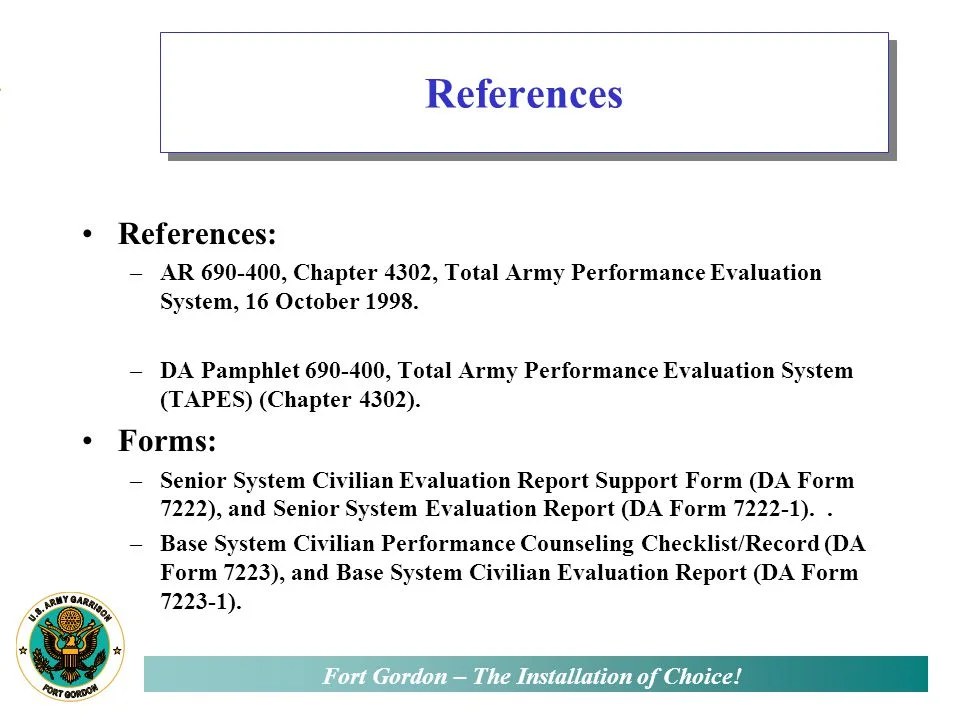
A valid Army evaluation normally uses the current official form for the member’s category, such as an OER, NCOER or AER where applicable. It identifies the authorised rater and reviewer, covers the prescribed assessment period and passes through the appropriate evaluation and examination process. A counsellor’s letter cannot replace or amend any part of that form.
A rape crisis counselor report may describe genuine administrative or clinical activity. For example, a civilian organisation might confirm that a soldier volunteered as a counsellor or supported survivors. Such evidence can support an authorised scoring criterion when the activity genuinely qualifies, but it cannot independently insert points, substitute for the rater’s judgement or become an EES evaluation merely because it is attached.
Clarify which record is actually being claimed: a formal evaluation, a supporting document, a commander’s justification or a private counselling record. This distinction prevents a sincere but private document from being repurposed as promotion paperwork without authority.
Verify the request through official Army channels
Start with the unit S-1, personnel specialist, evaluator or examiner. Ask for the exact form number, policy authority, submission destination and person responsible for entering the record. Guidance found in social-media posts or on unofficial websites is useful only as a prompt for questions, not as authority to upload material.
For Reserve Component personnel, the site’s reserve iPERMS access guide explains why iPERMS visibility can differ from evaluation status. Remember that viewing information in iPERMS does not give a soldier permission to load an evaluation into the system.
Obtain the answer in writing where possible. A commander’s verbal assurance that “the report gives points” is insufficient without an identified rule and the correct location for entering any award. If the source cannot explain how the document fits the evaluation, it should not be submitted as a formal Army record.
Prepare a compliant and privacy-conscious evidence package
If the activity is genuinely relevant, obtain confirmation directly from the organisation or qualified counsellor. The record should accurately state the person’s role, dates, duties and verifiable results. A self-written “counsellor evaluation” designed to attract points is not evidence of counselling experience and may undermine the credibility of the whole evaluation.
The authorised rater must then translate any relevant facts into the official evaluation. Clinical details, survivor information and unrelated personal history should be excluded unless an authorised requirement specifically calls for them. Templates that coach a soldier to claim false duties or guaranteed points can expose both the individual and the rater to administrative and disciplinary consequences.
Handle sensitive information under Australian realities
Counselling records may contain health information, allegations of sexual violence and identifying details about other people. In the U.S. Army, confidentiality depends on the route through which a report is made and the handling instructions attached to it. Access should be limited to people with an official need to know.
Australian privacy law is not a single regime. The Privacy Act 1988 applies to many private organisations, state and territory laws cover other entities, and Defence personnel follow internal records rules and exemptions. A U.S. Army confidentiality statement should not be assumed to provide identical protection under Australian law. Soldiers or family members in Australia should ask the relevant privacy officer how copies must be stored, transmitted and disposed of.
Local support is also different from Army evaluation support. Australians can contact RAINSBow on 1800 737 732 for confidential sexual-assault counselling, but an Australian support record has no authority in U.S. EES. Defence offices commonly use DefenceConnect, Teams and managed email, so forwarding evaluation material to a personal Gmail account, consumer cloud or unapproved USB drive creates avoidable risk.
Test promotion-point claims against current rules
Use the current evaluation instructions, applicable Army regulation and Human Resources Command policy to identify every claimed point. An unofficial arithmetic check can help, and Bannik’s point calculation guidance provides one such reference. It cannot authorise a point that is absent from the official criteria.
Broader general EES guidance can help distinguish evaluations, supporting records and promotion-point information. A claim should still be matched to the Soldier’s specific category, period and award authority; an OER example does not automatically apply to an NCOER or AER.
Keep a written record of each claimed point, its policy reference and who authorised it. Deadlines also need careful checking because many Australian offices operate on UTC+10 or UTC+11, while EES notices may display a U.S. date or time. Compare both calendars and retain screenshots of the official notice without assuming that a screenshot proves the underlying record was accepted.
Submit, confirm and retain the final record
Evaluation documents should travel through the authorised rater, reviewer and examiner or another documented personnel channel. Do not bypass that chain by uploading an attachment to iPERMS or emailing it to an evaluation office without instructions. If iPERMS appears unavailable, the iPERMS outage steps can help distinguish a temporary display problem from a record issue.
After submission, confirm that the evaluation, signatures and administrative review are complete, then retain a copy of the covering paperwork under the appropriate privacy rules. Any correction or rejected attachment should be handled through the examiner who identified the problem. The record becomes valid through recognised authority, an official evaluation form and controlled submission—not through the words “rape crisis counselor report” on an otherwise unofficial document.